
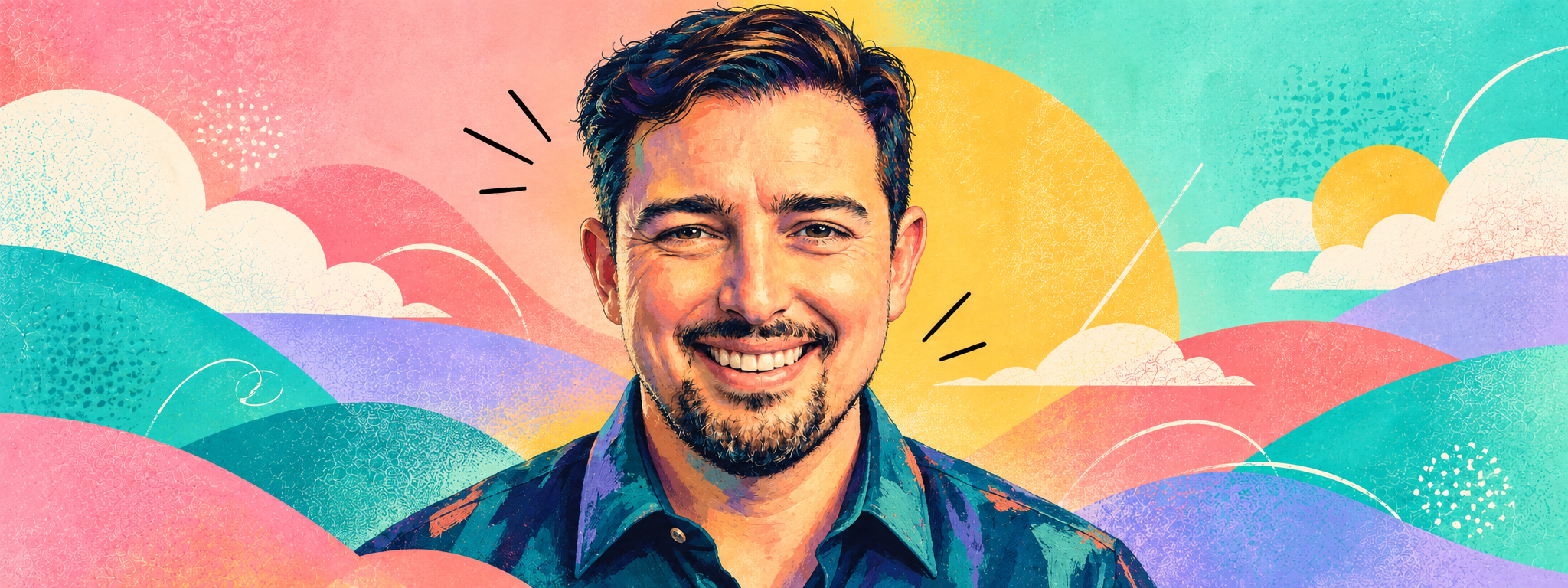
Getting to know Brian
Tell us a little about yourself. Who are you, and what’s your role at H2?
I’m the new Executive Creative Director at H2, and the way I see it, my job is to create a space where unexpected ideas can happen at a high frequency.
My secret is range. I’ve worked in markets across Canada and in all kinds of creative shops, (design, digital, advertising, experiential) so I don’t come at a problem with a favourite medium in mind. The idea and the media can be figured out together, starting from what the brand actually needs. Some of the most successful work I’ve been part of turned into things nobody saw coming, like a country album and a crowdfund for a starship.
Outside of work I’m a family man, with four teenaged kids including a set of twins, and they bring me an unreasonable amount of joy.
How did you find your way into creative work?
I was an artistic kid with a practical father who challenged me to find something creative that could actually pay the bills, and that turned out to be graphic design. One of my courses had a chapter on advertising that talked about brands spending oodles of money to do culturally relevant things, which sounded like a ton of fun, so that’s what I went after.
What’s kept me interested ever since is how new technology keeps changing what’s possible in culture. Right now that’s AI. It makes competent work cheap and endless, so the most valuable thing an agency can bring is the idea a machine would never land on, which raises the bar for human imagination.
What brought you to H2?
Independent agencies are best suited for what comes next. Things are changing fast, and an independent agency has the freedom to experiment and adapt.
You can see that ambition in how H2 works: Across a broad range of industries and not pigeonholed into one category or approach. The focus is on impact, on results and on doing the right thing for the client at the right moment.
There’s also some nice symmetry in my career returning to a Victoria-based independent agency. My first agency job out of school was with Copeland Communications [Ed. note: Hey, we’ve heard of them!]
Creativity and business results
When the budget is tight, where should a business put its creative effort to make the biggest difference?
Put creativity into both the message and the media, because when the two are designed together the chances of success are much higher. I look for the most impactful way to get the message across, find the natural habitat for the message and build in a way for people to share it.
I know it feels risky because putting the message in front of more people feels like the safer bet. But reach only pays off when people remember the message, talk about and delight in it, and strong craft is what gets them there. It makes every media dollar behind it go further.
What makes a creative risk worth taking, and how do you help a client judge that?
It comes down to experience and intuition, and as a culture I think we’ve lost our way when it comes to leading with our gut. Best practice is useful for telling you what’s worked before, while leaning on it to make the call lands you squarely in more of the same.
That doesn’t mean guessing, and a few things keep a gut call honest. The goal of the campaign needs to be clear, and the client and agency need to agree on what success looks like before anyone sees an idea. Then you do the work of seeing the tropes and clichés the category holds as gospel. Somewhere in that exploration is an audience truth that goes against that common knowledge. The tension between them gives the creative a defined place to land, and if an idea lands in there, the chances it works are much, much higher.
What have you changed your mind about when it comes to making creative work that gets results?
I used to believe great ideas came from someone with a genius brain and would just pop into effortless existence. When I started out, I may or may not have thought I had one of those genius brains. But experience has told me it is always a lot of work. Great ideas don’t just fall out of the tree, they take tons of exploration. Quantity has to come first, before quality is even a thing.
The best projects go something like this: Someone comes up with the kernel of the idea, then everyone builds on it and takes ownership of a different part. The excitement around it makes it bigger than any one person could have made it alone. You know this has happened when it’s hard to recall who the first iteration came from.
That’s changed how I think about a “creative team,” which extends past the creative department to everyone working on the project, including the client. When everyone understands and is comfortable in their role, they can bring creativity to their own function. That’s what makes an idea bigger than the sum of its parts, and those are the ideas that get the best results.