
AI Search Didn’t Kill SEO. It Made Brand Visibility More Important.
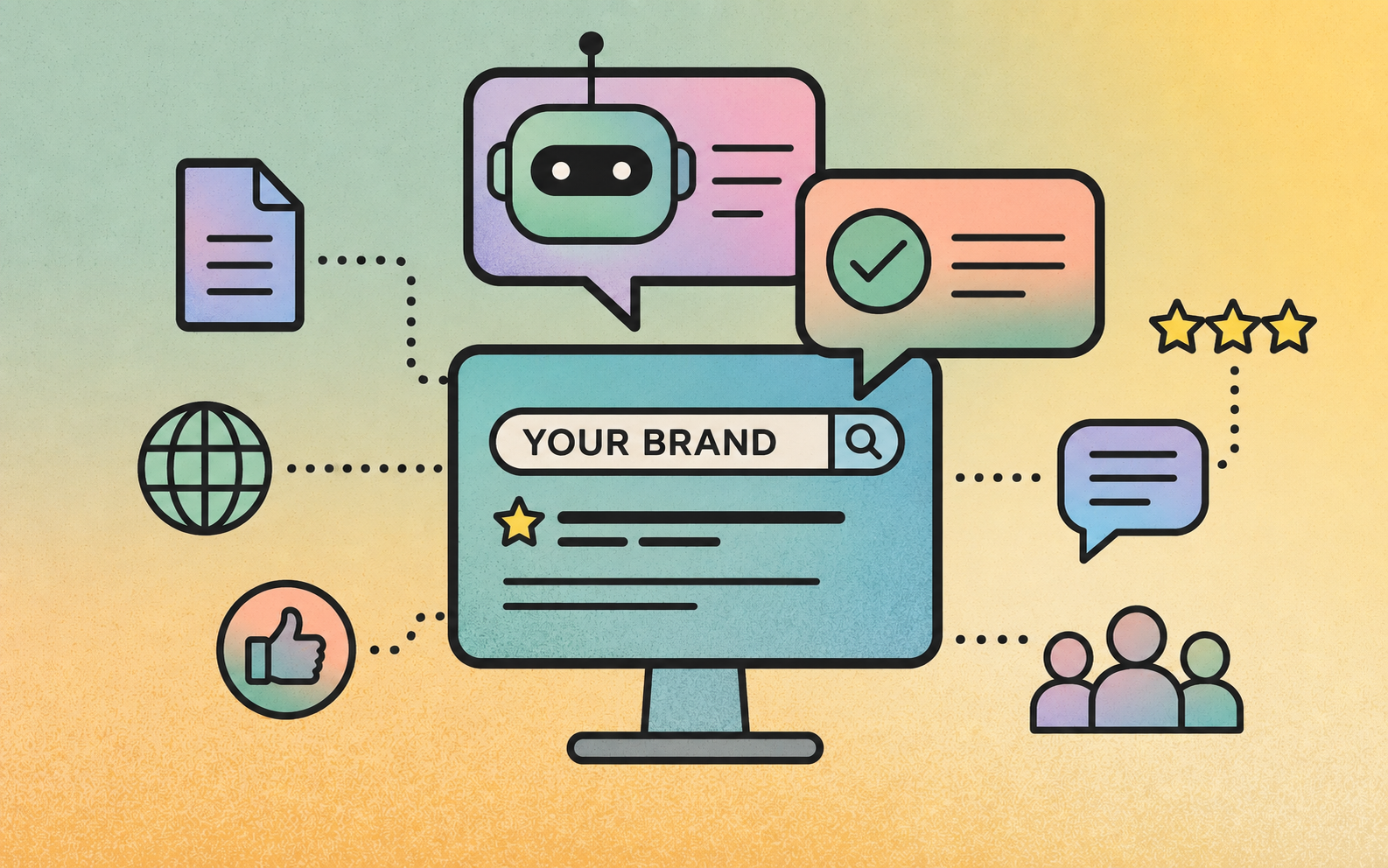
Generative AI and Large Language Models (LLMs) haven’t just disrupted SEO; they have completely reshaped the landscape. This is not some Google update or the slow competitive creep from Bing. The way people find information online is undergoing a massive shift, forcing brands to rethink how they earn search visibility. While traditional Google Search still remains the dominant player, taking up more than 85% of overall search volume (Statcounter), AI players are rapidly entering the scene, capturing an increasing amount of search volume. ChatGPT has by far the dominant share of global AI search volume, currently averaging 900M weekly users and 2.5B+ prompts per day (TechCrunch). But it doesn’t end there. Other AI generative tools commonly being used for both business and personal use include Gemini, Co-Pilot, Perplexity, and Claude. With SEO serving as an important step in the customer journey for years, brands are scrambling to make sense of the generative search disruption, to navigate the new AI distractions, and to learn how to be seen in AI search results.
New User Behaviour Emerges
Generative search disruption has gone beyond the search landscape and has uniquely changed the nature of the customer journey. You may not have noticed, but our consumer expectations have changed. We used to type a question into Google and receive a list of links to browse and evaluate ourselves. This humble query and foraging through search results to find an answer has quickly shifted to a nature of instant, on-demand problem-solving. I don’t want to go to the grocery store and decide what to make for dinner; instead, I’ll have HelloFresh deliver it to my door and tell me what to eat. As a result, our attention span for search has decreased, and if you didn’t think Page 2 on Google was a graveyard before, you will now. That shift is why generative search feels so disruptive for marketers. Visibility is no longer just about ranking on Google; it is also about whether AI tools surface, cite, and trust your brand during early consideration.
New Tools, Same Rules
As a result, generative search has created a new, justifiable distraction from traditional SEO efforts. As organic search traffic declines and AI tools capture more attention, many brands are pivoting toward one urgent question: how do we get recommended by AI? The distraction is warranted, but achieving AI visibility does not mean abandoning traditional SEO. Despite the lower overall organic search volume, this traffic is mainly research-oriented, and SparkToro confirmed AIs are inconsistent when recommending brands or products. This leaves room for traditional Google search to still play a vital role in the customer journey. Think about it, when you’re done planning your perfect Banff backpacking trip using AI, you still go to Google Search to make your campground reservation. Prospects are still going to Google for lower-funnel activity, which gives SEO a new sense of urgency. You do not want to spend months moving a cold prospect into a warm lead, only to lose them at the moment of purchase because a competitor was easier to find in search, and this is how I instead wound up in Kananaskis.
If AI is becoming a new form of upper-funnel activity, then the challenge for brands is not choosing between generative search and traditional SEO. The challenge is understanding how the two work together. For most brands, the biggest problem in generative search is brand awareness and being mentioned or cited in AI responses. That visibility still starts with traditional SEO. LLMs evaluate your website in many of the same ways search engines do: crawling your content, analyzing how your pages are connected, and using that information to better understand your brand. It is no coincidence that the brands ranking well in search are often the same ones that appear in AI-generated answers. What has changed is that your website is no longer the only signal that matters. In generative search, your brand is evaluated across the web through reviews, citations, social engagement, community participation, and third-party mentions. Instead of viewing AI visibility like a search registry, think of it more like digital PR for your brand. You are still trying to earn attention, but now part of the audience you need to win over is the LLM itself.
Digital PR Makeover
The best way to improve your digital PR for AI search visibility is to produce quality content that is clearly structured around useful ideas and written in easy-to-understand language. LLMs interpret this content, connect it to related topics, and use those signals to help respond to related queries. In a digital environment crowded with AI-generated content, clear, trustworthy work is more likely to stand out. For generative search, trust comes from signals like publication dates, author bios, cited sources, reviews, social engagement, and public forum discussions. These interactions help build community, which means brands cannot just publish content and walk away. They need to participate, respond, and reengage with their audience because useful content only gains value when people discuss, share, and validate it. That validation creates a cycle marketers can cultivate. Useful content earns engagement, engagement builds trust, and trust strengthens generative search visibility. The next question is how to decide what content is worth creating in the first place.
AI Visibility Reporting
Generative search visibility sounds great until you get asked the inevitable question: “How do I know our efforts are paying off if I can’t see my brand in AI results?” The honest answer is that AI visibility tracking is still not fully established. While some metrics are trackable, AI visibility should not be used as a standalone source for making marketing decisions. Instead, these metrics are best used as directional signals that show whether your content and brand-building efforts are gaining traction. AI Share of Voice, for example, can help measure how often your brand appears for certain queries compared to competitors, similar to how brands have historically tracked search visibility. This can include AI citations, brand mentions in responses, and references from AI bots or crawlers.
The value of AI visibility reporting is not that it gives marketers a perfect conversion metric. It is what gives teams more confidence in the brand-building work that is often difficult to measure. Strong creative, community engagement, useful content, and authentic thought leadership do not always show immediate ROI, but they are exactly the kinds of efforts that help a brand become more recognizable, trusted, and referenced over time. AI visibility reporting gives marketers another way to see whether that work is starting to show up in the broader digital landscape. And when teams have more confidence that their brand efforts are working, they are more likely to invest in the original, human, and emotionally compelling work that actually stands out.
The challenge facing marketers today is not learning how to game AI; it’s learning how to stand out in a world where AI is increasingly deciding which brands deserve attention. The good news is that the answer is remarkably familiar. Brands that publish useful, trustworthy content, participate in their communities, earn genuine engagement, and consistently demonstrate expertise are the brands most likely to be surfaced by both search engines and AI systems. Generative search may be changing how people discover information, but it has not changed what makes a brand credible. If anything, it has amplified it. The brands that focus on building trust rather than chasing shortcuts will not only earn greater visibility in AI-generated results but also build a stronger presence across the entire digital landscape.